




I’ve talked to a lot of first-time founders going through angel fundraising. Most of them start the same way. Polish the pitch deck, Google “angel investors [city name],” send a few cold emails, and wait.
But nothing comes back.
So they send more. Pitch more people. Spin their wheels for weeks, wondering what they’re doing wrong.
And honestly? It’s almost never the idea. Founders just pitch too early, target the wrong investors, and reach out the wrong way. Then the silence starts to feel like rejection, when the actual issue is that they had no real process.
So in this guide, I’m walking you through the exact process, from building your business plan to closing the deal. Let’s get into it.
Know if your startup is actually ready for angel funding
Before you research a single investor, answer one honest question: Are you actually ready?
First-time founders assume the answer is yes, the moment they have an idea they believe in. But angels are accredited investors. They meet the SEC’s threshold of $200,000+ in annual income ($300,000 joint) or $1 million+ net worth excluding their primary residence.
They evaluate deals every week. They know the difference between a founder who’s done the work and one who hasn’t.
You don’t need revenue to approach angels at the pre-seed stage. But you do need something that proves the idea is more than a slide deck.
That could be a working prototype, a waitlist with genuine signups, a few letters of intent from potential customers, or early feedback that proves people actually want what you’re building.
If you have none of those yet, my honest advice is to spend the next 60-90 days getting one. Not because angels won’t take meetings, but because you’ll have nothing concrete to anchor the conversation to, and a meeting without that rarely goes anywhere.
The founders who closed angel rounds aren’t necessarily further along than you. They just walked in with enough proof to make the risk feel calculated, not blind.
Finish your business plan and make it investor-ready
I’ve talked to founders who skip straight to the pitch deck. But here’s what gets missed: The business plan isn’t a document angels read instead of the deck. It’s what you build first, so your deck, your financials, and your story are all grounded in real thinking.
Here’s why it matters before you pitch anything:
- It helps you figure out how much money you actually need and why.
- It forces you to map out your market, revenue model, and financial projections before an investor pokes holes in them.
- It gives you the numbers and key points you’ll use in your deck and one-pager.
- And if an angel is interested, they’ll ask for it during due diligence. Having it ready signals you’ve done the work.
It’s worth understanding that angel funding is also an equity decision, not just a capital one. Before you commit to this path, read up on debt vs. equity financing and what giving up a stake actually means long term.
Don’t spend weeks on a plan that gets rejected
Finish your investor-ready business plan with AI

What kills a business plan in the first five minutes of review?
A few things I’ve noticed end deals before they even started. Angels go through hundreds of plans, so these patterns stand out faster than you’d expect.
- Not compelling executive summary. If your market, model, and ask aren’t clear on page one, the rest won’t get read.
- Projections with no logic behind them. Angels will ask how you got there. “We assumed 20% month-over-month growth” isn’t an answer.
- A vague or missing funding ask. How much are you raising, at what terms, and what milestone does it get you to?
- No mention of competition. Every market has alternatives. Pretending otherwise raises an immediate red flag.
- No risk analysis. Founders who act like everything will go perfectly lose credibility fast. Showing what could go wrong, and how you’d handle it, actually builds trust.
If any of these are in your current draft, fix them before the plan leaves your inbox. An angel who spots one of these in the first five minutes rarely reads further.
Build pitch materials (deck, one-pager, & 60-second pitch)
Once your business plan is solid, the next step is turning it into materials that angels actually use to evaluate deals. And here’s something most first-time founders miss: You don’t just need a pitch deck. You need 3 formats of the same story.
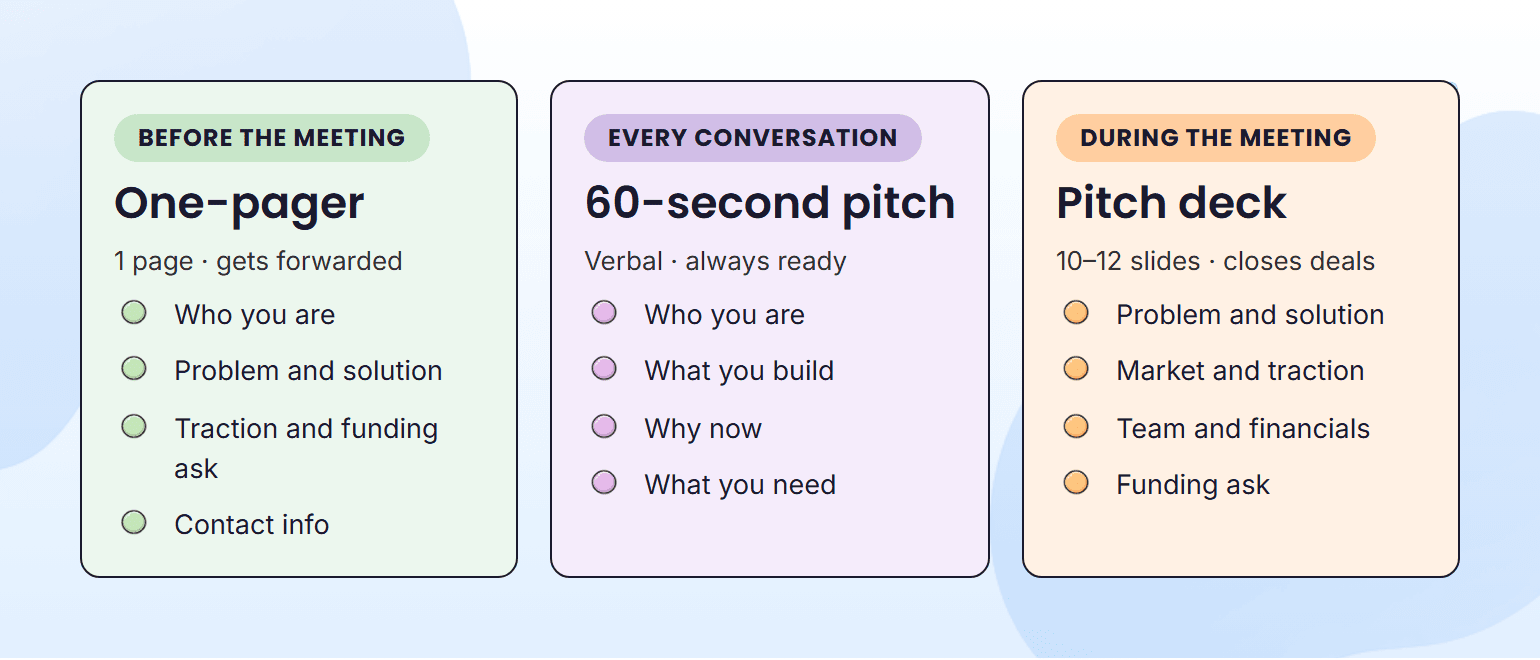
The one-pager is the format I’d prioritize first, even though founders rarely make one. Its job isn’t to close the deal. It’s to get forwarded. I often ask founders to send it before the deck, not after.
The deck is your main presentation. Many angels decide within the first three slides whether to keep reading, so each slide needs to reflect what investors actually look for in a pitch deck.
The 60-second pitch is trickier than it sounds. It’s simple until you try to do it naturally in a real conversation. Practice it until it stops sounding rehearsed.
One thing I always tell founders: Keep the numbers consistent across all three. If your deck says you’re raising $500,000 and your one-pager says $750,000, you look disorganized before the meeting even starts.
| Format | Length | When to send it | Don’t send it if… |
| One-Pager | 1 page | You have a warm intro lined up and need something forwardable | You haven’t finalized your ask or raise amount yet |
| 60-Second Pitch | 60 seconds | You’re heading into a networking event, demo day, or intro call | You still can’t explain what you do in one clear sentence |
| Pitch Deck | 10-12 slides | An investor has asked to see more after receiving your one-pager | You’re sending it cold without any prior contact |
Find and qualify the right angels
Some founders I’ve worked with treat this step like a search problem. Find as many angel investors as possible, pitch them all, see what sticks. I think that approach wastes months.
Finding angels isn’t the hard part. AngelList, Gust, the Angel Capital Association directory, and local angel groups will give you more names than you can ever reach out to. The hard part is qualifying them, figuring out which three to five are actually worth your time.
Here’s what to look for before reaching out to anyone:
Portfolio fit
Start here before anything else. A $25,000 check from an angel who’s backed companies in your category is worth more than a $100,000 check from someone learning your space on your round.
Check whether they already invest in your industry or adjacent ones. If yes, they understand your model without you having to explain it from scratch. If not, move them down the list.
Stage alignment
Some angels only write checks at pre-seed. Others prefer the seed stage with some traction behind it. Check their recent investments to see where they actually deploy capital, not just what they say they do.
Check size
Many individual angels write checks between $25,000 and $100,000 per deal. If you’re raising $500,000 and an angel typically writes $10,000 checks, they’re not the right lead investor for your round.
Conflicts
If they’ve already backed a direct competitor, the conversation is going nowhere. Simple as that.
Before you reach out to a single investor, I’d recommend creating a simple spreadsheet with name, portfolio focus, stage, typical check size, and any mutual connections. Twenty targeted pitches will always beat two hundred cold ones.
It helps you understand where angel rounds fit within broader funding rounds and what comes next after you close.
Getting the meeting: warm introductions and what to do without a network
You’ve identified your target angels. Now you need a way in.
I’ll be honest: Cold emails to investors rarely work for first-time founders. And when they do, it’s usually because the founder had something extraordinary to show.
If you’re a first-time founder with no traction yet, a cold email is mostly noise.
Warm introductions are how angel deals actually begin. Not because investors are gatekeepers who enjoy being inaccessible. But a trusted person vouching for you does more credibility work in one sentence than your entire pitch deck can do in fifteen slides.
What exactly do I say when I ask someone for an introduction?
This is where many founders get it wrong. They ask someone to “put in a good word” and leave it at that. Don’t do that. Make it easy for the person introducing you by writing the message yourself.
A forwardable blurb is two to three sentences: Who you are, what you’re building, and why this specific investor is relevant. Something like:
“This is [your name], founder of [company]. We’re building [one-sentence description] and have [traction signal]. Given [investor’s name] has backed companies like [relevant portfolio company], I thought there might be a fit.”
The introducer just hits forward.
Who should you ask? More people than you think are one connection away from an angel. Former colleagues, advisors, startup lawyers and accountants, and other founders who’ve raised, accelerator mentors.
I always tell founders to map their network before assuming they don’t have one. And if you genuinely don’t have those connections yet, you’re not out of options.
Angel group pitch nights, demo days, and startup events like those run through Techstars or local accelerator programs aren’t cold outreach. Investors attend these specifically to meet founders.
You’re not interrupting anyone. You’re showing up somewhere you were invited to show up.
The pitch, the negotiation, and closing the deal
You made it to the room. Everything up to this point was preparation. This is where it either comes together or falls apart.
Here’s what I’ve seen trip up even well-prepared founders: They treat the pitch like a performance. Rehearsed answers, polished slides, confident delivery.
But by the time you’re in that room, the angel has already read your one-pager and liked what they saw. They’re not evaluating your slides anymore. They’re evaluating you.
And what I’ve noticed they’re really watching is how you handle the uncomfortable moments.
When an angel pushes back on your revenue assumptions or questions your market size, your instinct might be to defend. But don’t do that. The better move is to acknowledge the uncertainty honestly.
“You’re right, that’s an assumption. Here’s the logic behind it, and here’s what would need to be true for it to hold.”
That kind of answer builds more trust than a confident defence of a number you can’t fully prove.
The same goes for moments when you genuinely don’t know something. Just say so. Angels have seen enough pitches to know first-time founders won’t have every answer. What kills credibility is guessing wrong or getting flustered.
I must say: The founders who close rounds aren’t the ones with the sharpest answers. They’re the ones who treat a tough question as a genuine conversation rather than a threat, stay composed, and leave the investor thinking “I can work with this person.”
That quality, more than anything on your slides, is what gets the wire sent.
Once the pitch is done, expect 3-4 weeks from follow-up to funding. Here’s what the closing process typically looks like:
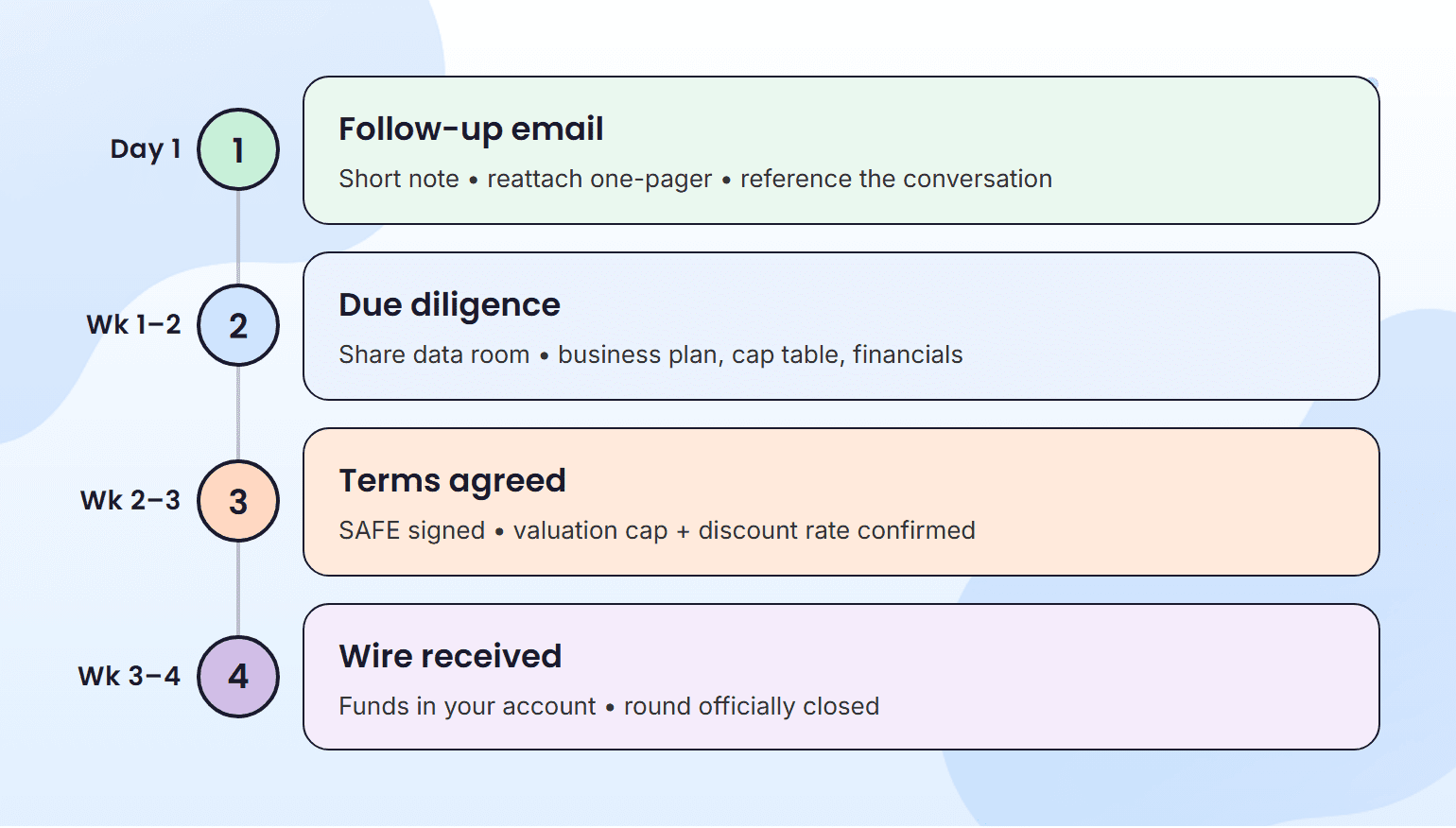
One thing I always walk founders through at this stage is the paperwork. First-timers expect a complicated negotiation. In practice, angel rounds close on a post-money SAFE (Simple Agreement for Future Equity). You agree on two things:
- Valuation cap: The maximum valuation at which your SAFE converts to equity. Lower cap = better deal for the investor.
- Discount rate: A reduced conversion price as a reward for investing early.
That’s largely it. Y Combinator’s free SAFE templates are the industry standard, and angels mostly expect them.
As for equity, I’d stay in the 10-15% range at pre-seed and 15-20% at seed. Before you sign anything, understand what a fair equity percentage actually looks like, and have a list of questions to ask investors ready. This helps you evaluate whether this person is the right partner, not just a willing one.
Conclusion
And that’s a wrap.
You now know the exact process: Validate your readiness, build an investor-ready business plan, prepare your pitch materials, find and qualify the right angels, get a warm introduction, and close the deal with confidence.
Honestly, none of this is as complicated as it looks from the outside. It just takes doing the work before you start pitching, not after.
If you’re building your business plan from scratch, Upmetrics’ AI business plan generator walks you through it section by section, which honestly saves a lot of time. Once that’s done, the pitch deck builder helps you turn it into something you can actually walk into a room with.
Don’t wait. Start planning now!
The Quickest Way to turn a Business Idea into a Business Plan
Fill-in-the-blanks and automatic financials make it easy.
