




Running an after-school program means making real decisions before a single child walks through the door. Which age groups to serve, how many staff state licensing requires, what to charge, and how to fill seats fast enough to cover payroll before the first full semester ends.
The numbers demand equal attention. Facility costs hit before enrollment opens, staff wages are fixed regardless of how many kids show up, and the gap between launch and break-even has to be funded. A solid plan maps that path clearly so a lender can see how the business will survive Year 1 and grow beyond it.
That’s what this sample plan for BrightPath After-School Academy is built to show. Read through it as a working reference and use the structure, financial tables, and operational details as the foundation for your own plan.
Executive Summary
BrightPath After-School Academy is a structured youth enrichment program launching in August 2026 in Bever Street, Wooster, OH 44691. Marcus Thompson, a former K-8 administrator with eight years of school system experience, built the program around a gap he watched play out firsthand: working families in Wooster with nowhere reliable to send their kids after the 3:00 PM bell.
Wooster’s after-school options are thin. The YMCA runs the main program in town but operates across four Wayne County locations with limited dedicated Wooster capacity. The only other licensed center has 54 children. For a district serving 3,209 students, that’s a significant gap.
BrightPath serves ages 5 to 14, operating 3:00 PM to 6:00 PM during the term and running a full-day, 10-week camp through the summer. We don’t just watch kids, we cycle them through four specific tracks:
- STEM
- Arts
- Academics
- Physical movement
Students are grouped by age to ensure the activities remain relevant and manageable for the staff. We’ve built our staffing model strictly around Ohio’s ratio laws, ensuring we stay compliant from our very first day in operation.
Crucially, school pickup is bundled into every enrollment tier. We identified transportation as the biggest roadblock for Wooster parents, so we solved it by providing a dedicated van for the school-to-center transition.
Marcus is requesting a $120,000 SBA 7(a) loan from Wooster Community Bank, paired with $40,000 in personal equity, for $160,000 in total startup capital. The funds cover leasehold improvements to a 3,200 sq ft facility, a 15-passenger school pickup van, STEM equipment, and more than five months of operating reserves.
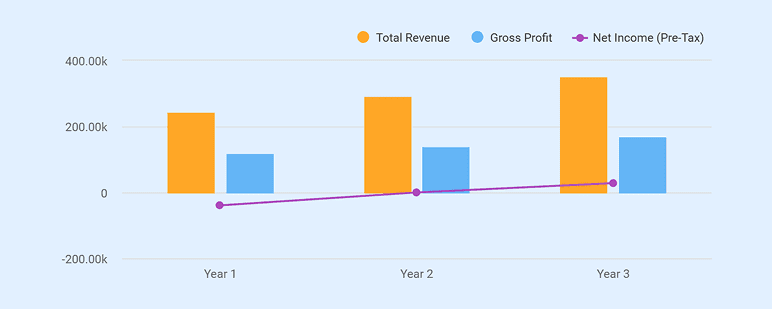
| Year 1 | Year 2 | Year 3 | |
| Avg. Enrolled Children | 60 | 72 | 86 |
| Total Revenue | $244,800 | $293,760 | $350,880 |
| Gross Profit | $117,994 | $141,592 | $169,125 |
| Net Income (Pre-Tax) | ($39,236) | $12 | $28,246 |
| Ending Cash | $45,678 | $45,612 | $72,801 |
Business Overview
BrightPath After-School Academy is an Ohio-registered, single-member LLC under the sole ownership of Marcus Thompson. Launching in August 2026, the company operates out of a leased spot in Wooster. We chose the LLC route for two reasons: it walls off personal liability and simplifies the tax process via pass-through reporting
Location & Facility
The facility is a 3,200 sq ft commercial space at 215 N Bever Street, Wooster, OH 44691, two blocks from Cornerstone Elementary School. This isn’t an accidental choice. Being that close makes the daily van shuttle fast and keeps us right in the neighborhood parents already know.
The space is divided into four dedicated zones:
- Main Activity Hub at 1,800 sq ft for group work
- STEM labs, a Quiet Zone at 600 sq ft for homework
- One-on-one reading, a Kitchen and Snack Area at 400 sq ft for food prep
- Downtime, and a Front Office at 400 sq ft for admin and parent check-in
Pre-opening renovations cover child-safe flooring, built-in storage, and outdoor access for physical activity periods.
Ownership
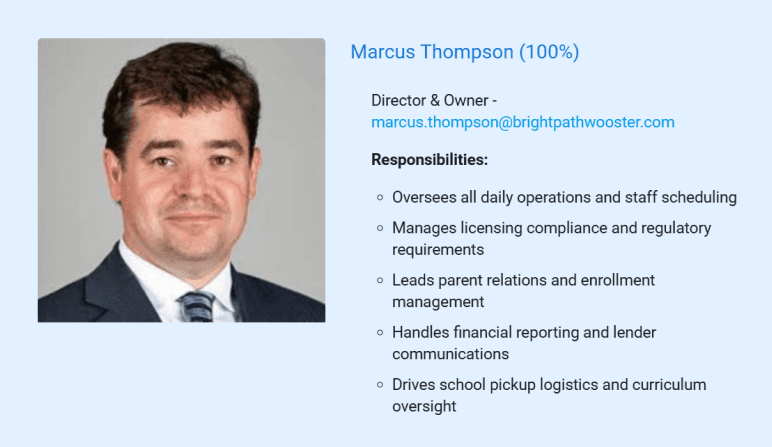
Marcus brings eight years of K-8 school administration experience to BrightPath, including direct oversight of after-school partnerships within his district. He holds a Bachelor of Education from Ohio University, a Child Development Associate (CDA) credential, and has completed the SBA Emerging Leaders program.
Mission Statement
The mission of BrightPath is to give working families a safe, high-quality place where kids don’t just wait for a ride home, but actually thrive socially and physically.
Business Model
BrightPath operates on an enrollment-based recurring revenue model. Families enroll every month, generating predictable income throughout the school year. The facility is licensed for up to 80 children per day.
Four enrollment tracks serve different family needs: full-time, part-time, drop-in, and summer camp. Monthly enrollment drives the core revenue base. Drop-in and summer camps provide supplemental income during slower periods, keeping cash flow steady across the full calendar year.
Market Analysis
The global after-school programs market was valued at $28.6 billion in 2025 and is projected to reach $54.3 billion by 2034, growing at a CAGR of 7.4%.
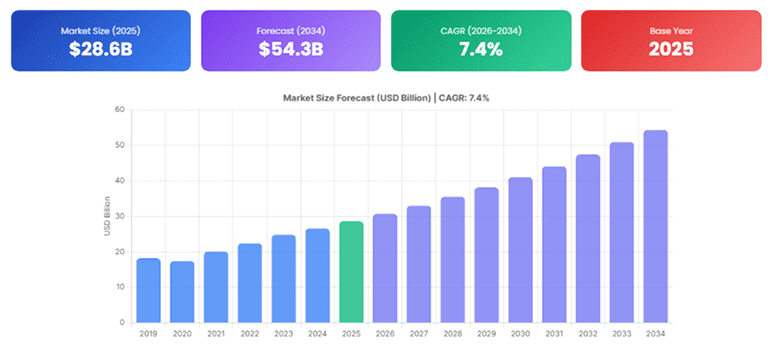
North America led all regions with a 38.5% revenue share, accounting for approximately $11.0 billion. That share is driven by one structural reality: the school day ends at 3:00 PM, and most parents don’t get home until 6:00 PM. That three-hour gap is the business.
Local Market: Wooster, Ohio
Wooster has 26,854 residents and a median household income of $66,898, placing it squarely in the working-family income range that BrightPath’s $350 monthly pricing is built for. The city is the county seat of Wayne County and home to a stable, year-round residential population with a median age of 40, well past the college-student skew that distorts demand signals in smaller Ohio towns.
The Wooster City School District serves 3,209 students across seven schools and spends $14,679 per student annually, reflecting a district that takes education seriously. That investment signals a parent base that values structured learning and is receptive to enrichment programs that extend it beyond the school day.
Target Customer
BrightPath serves working parents in Wooster with children ages 5 to 14. These families need reliable care between 3:00 PM and the end of the workday, not a luxury program.
The customer base splits across three household types: dual-income households (60%), single parents (25%), and guardian caregivers (15%), such as grandparents who can’t manage the daily school run consistently.
Each group has a different pressure point. Dual-income families treat after-school care as a functional requirement. Single parents put reliability and school pickup above everything else. Guardian caregivers need a consistent solution they can count on without being physically present every day.
Competitive Analysis
BrightPath enters a market where existing options are either too expensive, too limited in capacity, or too thin on programming to meet what Wooster families actually need.
Direct Competitors
Direct competitors are licensed programs serving the same age group, same hours, and same families as BrightPath.
Wayne County YMCA After-School is the most established program in the area, charging $275 a month. It carries strong brand trust and runs sports-heavy programming that families appreciate. The problem is availability. The program operates across four Wayne County locations with limited dedicated capacity in Wooster and runs a waitlist of 30 or more families. STEM programming is minimal.
Clubhouse Kids is a licensed center in Wooster with a maximum school-age capacity of 54 children. It serves the same age group and hours but offers limited enrichment programming beyond basic supervision. At capacity, it turns families away with no structured alternative in place.
Cornerstone Elementary School After-School Program operates inside the school building and serves a limited number of students. It is convenient for families at that specific school, but it does not offer transportation, STEM, or arts programming, and availability is restricted to enrolled Cornerstone students.
Indirect Competitors
These options solve the “childcare” problem in different ways and still compete for the same wallet.
- Informal Home Care: Including grandparents, neighbors, and babysitters is the most common alternative. At $20 an hour across 15 weekly hours, a babysitter costs over $1,200 a month with no structured programming or curriculum included.
- Sports & Activity Clubs: Martial arts, dance, or soccer leagues take up those after-school hours, but they only cover one specific niche. Parents are still left arranging care around the 45-minute practice sessions.
- Academic Tutoring (Bright Minds): These centers focus purely on grades and can easily cost $500+ a month. It’s great for math, but it ignores physical activity, arts, and the need for general daily care.
- Scouts & Church Groups: Very low cost and great for enrichment, but they aren’t a daily solution. They don’t offer school pickups or the consistent 3:00–6:00 PM coverage working parents actually need.
Competitor Positioning
BrightPath occupies a position none of the existing options do. The Young Men’s Christian Association (YMCA) has the brand trust but not the capacity or the STEM programming. Clubhouse Kids has the license but not the enrichment depth. The school program has the location, but not the availability or the transportation. Informal care has the flexibility but not the structure. Tutoring centers have the academics, but not the age range, the pickup, or the price.
BrightPath combines what each competitor does partially into one program. STEM and arts programming, homework support, physical activity, school pickup, ages 5 to 14, licensed for 80 children, and priced at $350 a month. No waitlist at launch.
The price point is deliberate. At $350, BrightPath sits above informal care, below tutoring centers, and above the YMCA by $75. That $75 difference buys a broader program, a guaranteed spot, and a school pickup route that most Wooster families cannot get anywhere else
Programs & Enrichment Services
Most programs stick to one thing, but BrightPath pulls four different enrichment tracks into one affordable package. It’s built to give parents options that actually fit their budget and their kids’ needs without making things complicated.
After-School Enrichment Program
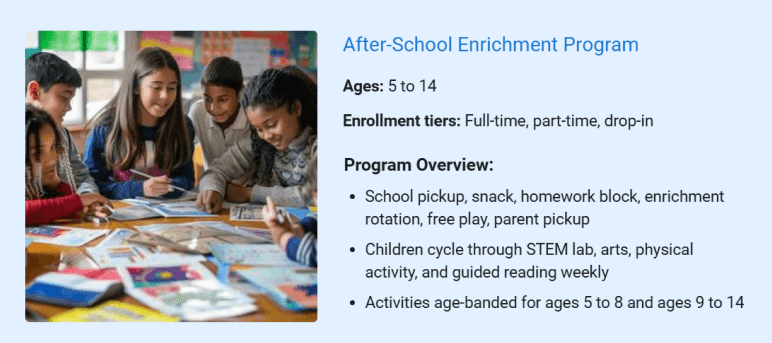
Monday through Friday, 3:00 PM to 6:00 PM. Every afternoon runs the same structured sequence from school pickup to parent collection.
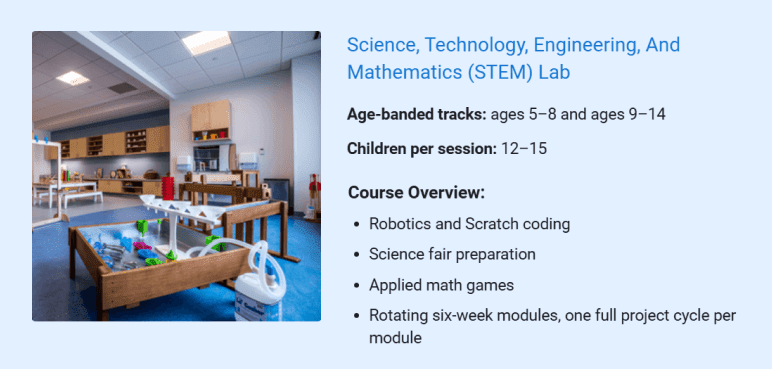
Science, Technology, Engineering, And Mathematics (STEM) Lab
Every Tuesday and Thursday, 4:15 PM to 5:15 PM. Included in all enrollment fees with no add-on cost.
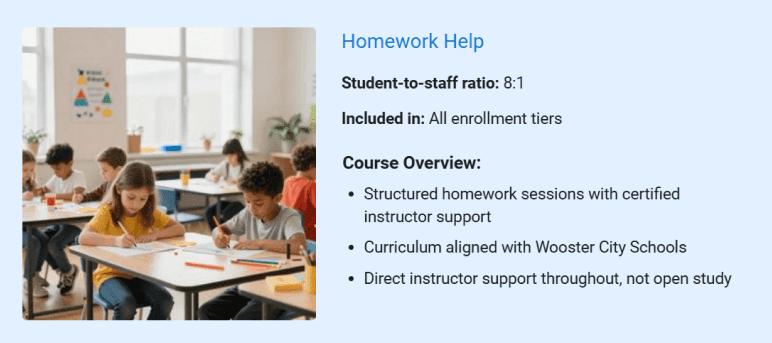
Homework Help
Every day, 3:30 PM to 4:15 PM. Every child leaves with their assigned work completed.
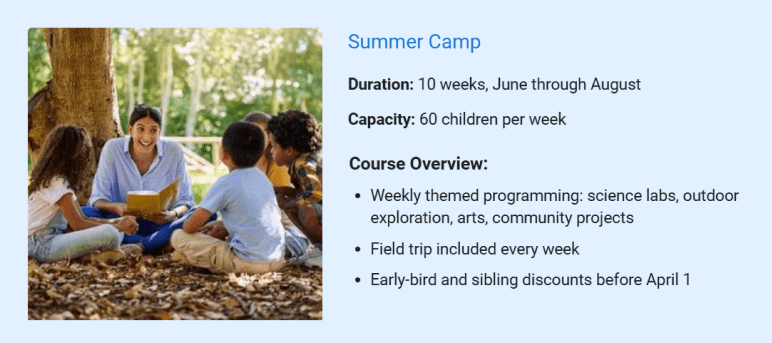
Summer Camp
Monday through Friday, 8:00 AM to 5:00 PM, June through August. Ten weeks of themed programming and weekly field trips.
Marketing & Enrollment Strategy
BrightPath’s marketing plan prioritizes local visibility and parent referrals over broad advertising. The annual ongoing budget is $6,000, preceded by a one-time $8,000 pre-launch spend before the August 2026 opening.
Marketing Channels
- Website & Online Enrollment ($3,000): This is the main engine for capturing leads. Parents can browse the program details, look over the pricing, and actually finish the enrollment process right there without needing to call us or visit in person first.
- Facebook & Instagram Ads ($2,000): We’re targeting these specifically to Wooster parents within a 10-mile radius. These ads run for the full six weeks leading up to launch, pushing traffic toward the site and our open house sign-up page.
- Community Open House ($1,500): A facility walkthrough where parents meet Marcus, tour the space, and ask questions before enrolling. Families who visit in person convert at a significantly higher rate than those who only see an ad.
- Google Business Profile ($1,000): We need to make sure BrightPath shows up immediately when someone searches for “after-school care in Wooster.” We’ll have photos and reviews ready to go before the first day.
- School Flyers & Print ($500): These are simple, physical flyers for Cornerstone Elementary and other Wooster City Schools. We’ll be distributing these throughout the final six-week countdown to launch.
Enrollment Funnel
BrightPath handles new families using a five-step pipeline:
- Website Inquiry: Parents usually find us through search, social posts, or word-of-mouth and hit the contact form. We keep a hard 24-hour cap on response times—if they’re waiting longer than a day, they’ve already moved on to the next school.
- Facility Tour: We get parents in the door during actual operating hours. Seeing the program in action matters. In Year 1, Marcus leads every single one of these tours himself.
- Free Trial Day: We let the child spend a full afternoon here for free. Once a kid actually experiences the program, the “sell” becomes a lot easier for the parents.
- Enrollment Form: This is all done online. The parent fills out the basics, submits their authorized pickup list, and picks their tier.
- First Month Payment: Once the first payment hits, the family is set. We use auto-renewal to keep everyone enrolled for the whole school year so they don’t have to deal with monthly paperwork.
Retention
Enrollment doesn’t stop at the first month. BrightPath keeps families engaged through monthly parent newsletters, quarterly progress conferences, and end-of-semester showcases where children present what they built in the STEM Lab. Families who stay enrolled for 12 consecutive months receive a 5% loyalty discount on their next cycle. The goal is simple: make leaving feel like a step backward.
We also offer a referral bonus. Every enrolled family gets a $50 enrollment credit for each new family they refer.
Operations Plan
BrightPath operates Monday through Friday, 3:00 PM to 6:00 PM during the school year and 8:00 AM to 5:00 PM during summer camp. The facility is closed on federal holidays, during spring break, and for two weeks in August before the program year begins.
Daily Schedule
We run every school day on a precise sequence. When you’re moving 60 to 80 children through a 3200 sq. ft. facility, consistency is the only thing standing between a smooth operation and chaos.
Staff hit the ground at 2:30 PM to prep all four zones. The goal is to have every station ready before a single child arrives. By 3:00 PM, the van is at Cornerstone Elementary; it takes two quick trips to get everyone back by 3:15 PM. Kids check in at the front desk and head right to the kitchen for snacks.
The 3:30 PM to 4:15 PM slot is reserved for the Quiet Zone homework block. Once that wraps, the enrichment rotation takes over the Main Activity Hub. Depending on the day, kids cycle through the STEM lab, art projects, or gym time.
We open up for free play at 5:15 PM, which leads into the parent pickup window starting at 5:45 PM. We don’t mess around; security photo ID verification is mandatory for every collection at the front office. Doors close at 6:00 PM sharp, giving the team until 6:30 PM to handle cleanup and reset for the next day.
Staff Ratio
Our building is capped at a maximum of 80 children daily to stay within safety limits. To stay compliant with Ohio DJFS standards, we maintain a 15:1 ratio for our younger group (ages 5–8) and an 18:1 ratio for the older kids (9–14). When we are running at full capacity, we always make sure at least five staff members are active on the floor.
Staffing Structure
Our team consists of qualified educators and support staff who are all background-checked and CPR-certified. Summer adds extended hours + 2 seasonal hires. The yearly salary of the owner and staff combined is $55,000.
| Role | Responsibility |
| Marcus Thompson (Director) | Daily operations, staff scheduling, parent relations, licensing compliance, and school pickup run |
| Lead Instructor 1 (STEM) | STEM lab delivery, robotics and coding sessions, six-week module planning |
| Lead Instructor 2 (Arts) | Arts enrichment delivery, creative project planning, and activity hub supervision |
| Admin/Front Desk | Parent check-in and checkout, enrollment records, digital sign-in, visitor management |
| Part-Time Aide 1 | Child supervision, homework block support, free play monitoring |
| Part-Time Aide 2 | Child supervision, pickup run support, zone coverage |
Technology and Systems
We rely on four key systems to keep the facility running lean without a massive administrative staff:
Enrollment & Billing via Sawyer: We use Sawyer to handle the heavy lifting of online registration and recurring monthly bills. It automatically applies sibling discounts and manages auto-renewals. The biggest win is the parent portal; families handle their own payment updates, so we don’t have to waste time at the front desk taking credit card numbers over the phone.
Attendance Tracking with EZChildTrack: This is our digital sign-in/out system. Every check-in is timestamped, creating a bulletproof attendance record. It’s a safety tool first; it flags unauthorized pickup attempts instantly, but it also generates the exact attendance reports we need to stay compliant with Ohio DJFS licensing.
Verkada Security Coverage: We’ve installed Verkada cameras to monitor all four zones. The footage stores directly to the cloud, meaning Marcus can check in on the facility from his phone at any time. It meets all state safety requirements and gives parents that extra layer of confidence when they ask about facility security.
Parent Communication (Sawyer App): Instead of staff spending hours on the phone, we use the Sawyer app for daily updates. We push out photos, activity summaries, and real-time pickup alerts. It keeps the parents “in the loop” while letting our instructors focus on the kids instead of their screens.
Equipment
BrightPath’s equipment is organized around the four program zones. The main activity hub runs on STEM kits, robotics components, and art supplies that rotate through six-week modules. Four dedicated computer stations support coding sessions through Scratch and science fair preparation. Sports and physical activity equipment covers the daily free play and movement block.
The 15-passenger van is the single most critical piece of equipment in the program. It runs two pickup trips every afternoon starting at 3:00 PM. Everything else in the daily schedule depends on it arriving on time.
All equipment is stored in locked cabinets after each session. STEM kits and robotics components are inventoried at the end of every six-week module before the next rotation begins.
Licensing, Safety & Compliance
Licensing & Core Permits
BrightPath operates under an Ohio DJFS Type A license, which is the state requirement for programs with 13 or more kids. This involves a 60 to 90-day vetting period that includes our Ohio Secretary of State LLC registration, a Wooster local business license, and a commercial occupancy permit to prove the building is fit for childcare.
Safety is non-negotiable, so we maintain a current Fire Safety Certificate and Wayne County Health Department approval for our kitchen and sanitation. Since we transport students, we also carry a commercial auto registration for our 15-passenger van through the Ohio BMV.
Compliance & Staffing
Every team member must pass BCI (Bureau of Criminal Investigation) and FBI (Federal Bureau of Investigation) background checks before their first day. All staff must hold either a Child Development Associate (CDA) credential or a minimum of two years of documented youth education experience. Marcus meets the Ohio DJFS director qualification standard with his Bachelor of Education and CDA credentials.
Operations & Safety
We pay about $6,000 a year for a solid insurance package that includes $1M/$2M liability, plus auto and workers’ comp. For daily security, we use a digital check-in system and never release a child without a photo ID match against our authorized list.
Safety is a constant priority, so we make sure at least one person on the floor is always CPR and first aid certified. We also stick to a formal emergency plan and run safety drills with the kids every semester to keep everyone ready.
Financial Plan
BrightPath’s financial plan shows how the program generates revenue, what it spends, and how the business grows over three years. The numbers are based on actual enrollment mix, licensed capacity, and the pricing structure across all four tracks.
Key Financial Assumptions
| Item | Assumption |
| FORECAST PERIOD & LAUNCH | |
| Forecast period | Year 1–3 (August 2026 – Year 3 end) |
| Launch date | August 2026 |
| REVENUE | |
| Blended avg. Revenue per child-month | $340 (weighted: FT $350, PT $225, drop-in $30/day, summer $275/wk) |
| Avg. enrolled children Year 1 | 60 |
| Avg. enrolled children Year 2 | 72 |
| Avg. enrolled children Year 3 | 86 |
| Revenue formula | Children × $340 × 12 months |
| Year 1 Revenue | 60 × $340 × 12 = $244,800 |
| Year 2 Revenue | 72 × $340 × 12 = $293,760 |
| Year 3 Revenue | 86 × $340 × 12 = $350,880 |
| COGS | |
| Direct materials/supplies | 10% of revenue (snacks, art supplies, STEM consumables, cleaning supplies) |
| Direct labor instructors & aides | 38% of revenue |
| Payroll taxes on direct labor | 10% of direct labor (FICA + Ohio unemployment) |
| OPERATING EXPENSES | |
| Owner + staff salary | $55,000/year (all years, fixed) |
| Payroll taxes on the owner’s + staff salary | 10% = $5,500/year |
| Facility rent | $2,800/month = $33,600/year |
| Insurance (GL + professional) | $6,000/year |
| Accounting & legal | $4,000/year |
| Phone & utilities | $4,800/year |
| Ongoing marketing | $6,000/year |
| Fuel & vehicle expenses | $3,600/year |
| Repairs & maintenance | $2,000/year |
| Technology subscriptions | $2,400/year |
| One-time Year 1 marketing launch | $8,000 |
| One-time Year 1 licenses & permits | $3,000 |
| One-time Year 1 professional services | $4,000 |
| WORKING CAPITAL | |
| Accounts receivable (DSO) | Net 15 days (Revenue ÷ 365 × 15) |
| Accounts payable (DPO) | Net 15 days (COGS ÷ 365 × 15) |
| Inventory days on hand | 10 days (COGS ÷ 365 × 10) |
| LOAN | |
| Lender | Wooster Community Bank |
| Loan amount | $120,000 SBA 7(a) |
| Term | 10 years (120 months) |
| Interest rate | 7.50% fixed |
| Monthly payment | $1,424 |
| DEPRECIATION | |
| Leasehold improvements ($25,000) | $2,500/yr (10-year straight-line) |
| Furniture & fixtures ($12,000) | $1,714/yr (7-year straight-line) |
| Computer equipment ($8,000) | $1,600/yr (5-year straight-line) |
| STEM & activity equipment ($6,000) | $1,200/yr (5-year straight-line) |
| Vehicle ($18,000) | $3,600/yr (5-year straight-line) |
| Total annual depreciation | $10,614/year |
| TAX | |
| Tax treatment | Pre-tax only (pass-through LLC taxes paid personally by owner) |
| FUNDING | |
| SBA 7(a) loan | $120,000 |
| Owner equity | $40,000 |
| Total startup capital | $160,000 |
Startup Costs
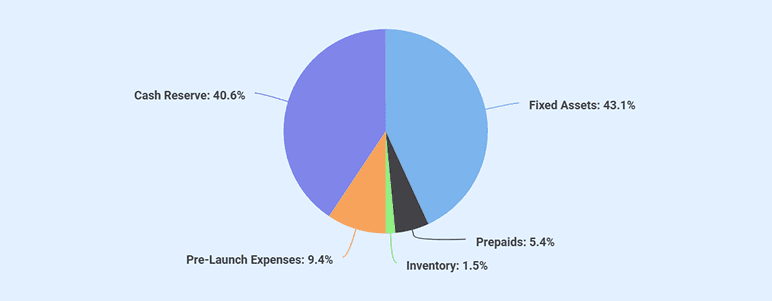
| Category | Cost | Accounting Treatment |
| Capitalized Assets (Fixed Assets) | ||
| Leasehold improvements | $25,000 | Depreciated over 10 years |
| Vehicle (used passenger van) | $18,000 | Depreciated over 5 years |
| Furniture & fixtures | $12,000 | Depreciated over 7 years |
| Computer equipment (5 stations) | $8,000 | Depreciated over 5 years |
| STEM & activity equipment | $6,000 | Depreciated over 5 years |
| Subtotal Fixed Assets | $69,000 | |
| Prepaid Expenses | ||
| Security deposit (2 months × $2,800) | $5,600 | Prepaid expense consumed Year 1 |
| Prepaid insurance (12 months) | $3,000 | Prepaid expense consumed Year 1 |
| Subtotal Prepaids | $8,600 | |
| Current Assets | ||
| Initial supplies inventory | $2,400 | Current asset expensed as COGS |
| Subtotal Inventory | $2,400 | |
| One-Time Pre-Launch Expenses (expensed Year 1) | ||
| Marketing launch (website, signage, ads) | $8,000 | Year 1 OpEx |
| Licenses & permits | $3,000 | Year 1 OpEx |
| Professional services (legal, LLC setup) | $4,000 | Year 1 OpEx |
| Subtotal Pre-Launch Expenses | $15,000 | |
| Cash Reserve | ||
| Working capital reserve (opening cash) | $65,000 | Cash is not an expense |
| Subtotal Cash Reserve | $65,000 | |
| TOTAL STARTUP CAPITAL DEPLOYED | $160,000 |
Sources of Funds
| Source | Amount |
| SBA 7(a) loan Wooster Community Bank | $120,000 |
| Owner equity, Marcus Thompson | $40,000 |
| Total Startup Capital | $160,000 |
Profit & Loss Statement (3 Years)
| Line Item | Year 1 | Year 2 | Year 3 |
| Avg. Enrolled Children/Month | 60 | 72 | 86 |
| Total Revenue | $244,800 | $293,760 | $350,880 |
| COST OF GOODS SOLD | |||
| Direct materials/supplies (10%) | $24,480 | $29,376 | $35,088 |
| Direct labor instructors & aides (38%) | $93,024 | $111,629 | $133,334 |
| Payroll taxes on direct labor (10%) | $9,302 | $11,163 | $13,333 |
| Total COGS | $126,806 | $152,168 | $181,755 |
| Gross Profit | $117,994 | $141,592 | $169,125 |
| Gross Margin | 48.2% | 48.2% | 48.2% |
| OPERATING EXPENSES | |||
| Owner + staff salary | $55,000 | $55,000 | $55,000 |
| Payroll taxes on owner + staff salary (10%) | $5,500 | $5,500 | $5,500 |
| Facility rent ($2,800/month) | $33,600 | $33,600 | $33,600 |
| Insurance | $6,000 | $6,000 | $6,000 |
| Accounting & legal | $4,000 | $4,000 | $4,000 |
| Phone & utilities | $4,800 | $4,800 | $4,800 |
| Ongoing marketing | $6,000 | $6,000 | $6,000 |
| Fuel & vehicle expenses | $3,600 | $3,600 | $3,600 |
| Repairs & maintenance | $2,000 | $2,000 | $2,000 |
| Technology subscriptions | $2,400 | $2,400 | $2,400 |
| Marketing launch (one-time) | $8,000 | — | — |
| Licenses & permits (one-time) | $3,000 | — | — |
| Professional services setup (one-time) | $4,000 | — | — |
| Total Operating Expenses | $137,900 | $122,900 | $122,900 |
| EBITDA | $(19,906) | $18,692 | $46,225 |
| Depreciation | $10,614 | $10,614 | $10,614 |
| EBIT | $(30,520) | $8,078 | $35,611 |
| Interest expense | $8,716 | $8,066 | $7,365 |
| Net Income (Pre-Tax) | $(39,236) | $12 | $28,246 |
Cash Flow Statement (3 Years)
| Line Item | Year 1 | Year 2 | Year 3 |
| Beginning Cash | $80,000 | $45,678 | $45,612 |
| OPERATING ACTIVITIES | |||
| Net income (pre-tax) | $(39,236) | $12 | $28,246 |
| Depreciation (non-cash add-back) | $10,614 | $10,614 | $10,614 |
| Change in accounts receivable | $(10,060) | $(2,012) | $(2,348) |
| Change in inventory | $(1,074) | $(695) | $(811) |
| Change in accounts payable | $5,211 | $1,042 | $1,216 |
| Change in prepaid expenses | $8,600 | $0 | $0 |
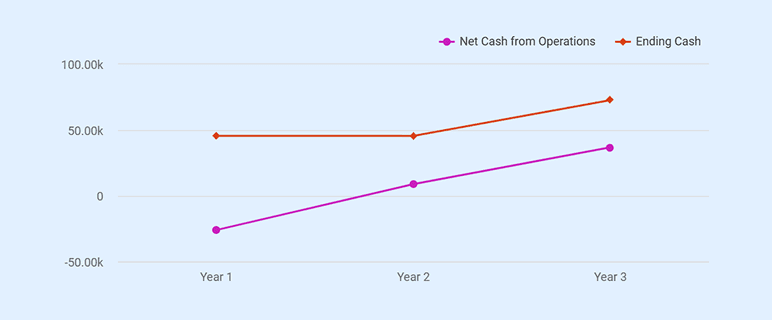
| Net Cash from Operations | $(25,945) | $8,961 | $36,917 |
| INVESTING ACTIVITIES | |||
| Capital expenditures | $0 | $0 | $0 |
| Net Cash from Investing | $0 | $0 | $0 |
| FINANCING ACTIVITIES | |||
| Loan principal repayment | $(8,377) | $(9,027) | $(9,728) |
| Net Cash from Financing | $(8,377) | $(9,027) | $(9,728) |
| Net Change in Cash | $(34,322) | $(66) | $27,189 |
| Ending Cash | $45,678 | $45,612 | $72,801 |
Opening Balance Sheet (Day 0)
| Line Item | Amount |
| ASSETS | |
| Cash (working capital reserve + pre-launch expense float) | $80,000 |
| Inventory (initial supplies) | $2,400 |
| Prepaid expenses (security deposit + prepaid insurance) | $8,600 |
| Gross PP&E (fixed assets) | $69,000 |
| Total Assets | $160,000 |
| LIABILITIES & EQUITY | |
| SBA 7(a) term loan | $120,000 |
| Owner’s contributed capital | $40,000 |
| Total Liabilities + Equity | $160,000 |
Balance Sheet (Years 1-3)
| Line Item | Year 1 | Year 2 | Year 3 |
| ASSETS | |||
| Cash | $45,678 | $45,612 | $72,801 |
| Accounts receivable | $10,060 | $12,072 | $14,420 |
| Inventory | $3,474 | $4,169 | $4,980 |
| Prepaid expenses | $0 | $0 | $0 |
| Gross PP&E | $69,000 | $69,000 | $69,000 |
| Less: accumulated depreciation | $(10,614) | $(21,228) | $(31,842) |
| Net PP&E | $58,386 | $47,772 | $37,158 |
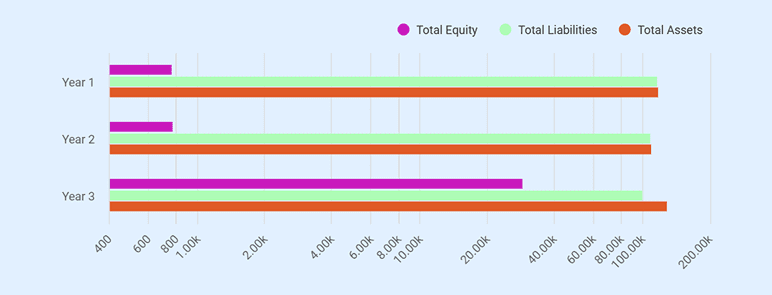
| Total Assets | $117,598 | $109,625 | $129,359 |
| LIABILITIES | |||
| Accounts payable | $5,211 | $6,253 | $7,469 |
| SBA term loan balance | $111,623 | $102,595 | $92,867 |
| Total Liabilities | $116,834 | $108,848 | $100,336 |
| EQUITY | |||
| Contributed capital | $40,000 | $40,000 | $40,000 |
| Retained earnings (cumulative) | $(39,236) | $(39,224) | $(10,978) |
| Total Equity | $764 | $776 | $29,022 |
| Total Liabilities + Equity | $117,598 | $109,624 | $129,358 |
Break-Even Analysis
| Item | Value |
| Average revenue per child-month | $340 |
| Direct materials cost per child-month (10%) | $34 |
| Direct labor cost per child-month (38%) | $129 |
| Payroll taxes on direct labor (10% of $129) | $13 |
| Total variable cost per child-month | $176 |
| Contribution margin per child-month | $164 |
| Contribution margin % | 48.2% |
| Annual fixed operating costs (Year 2 steady-state) | $122,900 |
| Break-even child-months per year | 749 |
| Break-even children per month | 63 |
| Break-even revenue (annual) | $254,880 |
The Quickest Way to turn a Business Idea into a Business Plan
Fill-in-the-blanks and automatic financials make it easy.
